Articles · General information
How to Give a Witness Statement After a California Car Accident
If you witnessed a crash, a clear account of what you personally saw may help explain the sequence of events. This guide to how to give a witness statement after a California car accident focuses on practical steps: record observations while fresh, preserve your contact information, and distinguish facts from assumptions. You do not need to decide who was legally at fault.
What should you do before giving a statement?
Start with safety. Move away from traffic if you can do so safely. If anyone may be injured or there is an immediate hazard, call emergency services. Do not enter a roadway, approach an unsafe vehicle, or delay urgent help to take photographs or make notes. If responders are present, give them concise information about an urgent danger you personally observed.
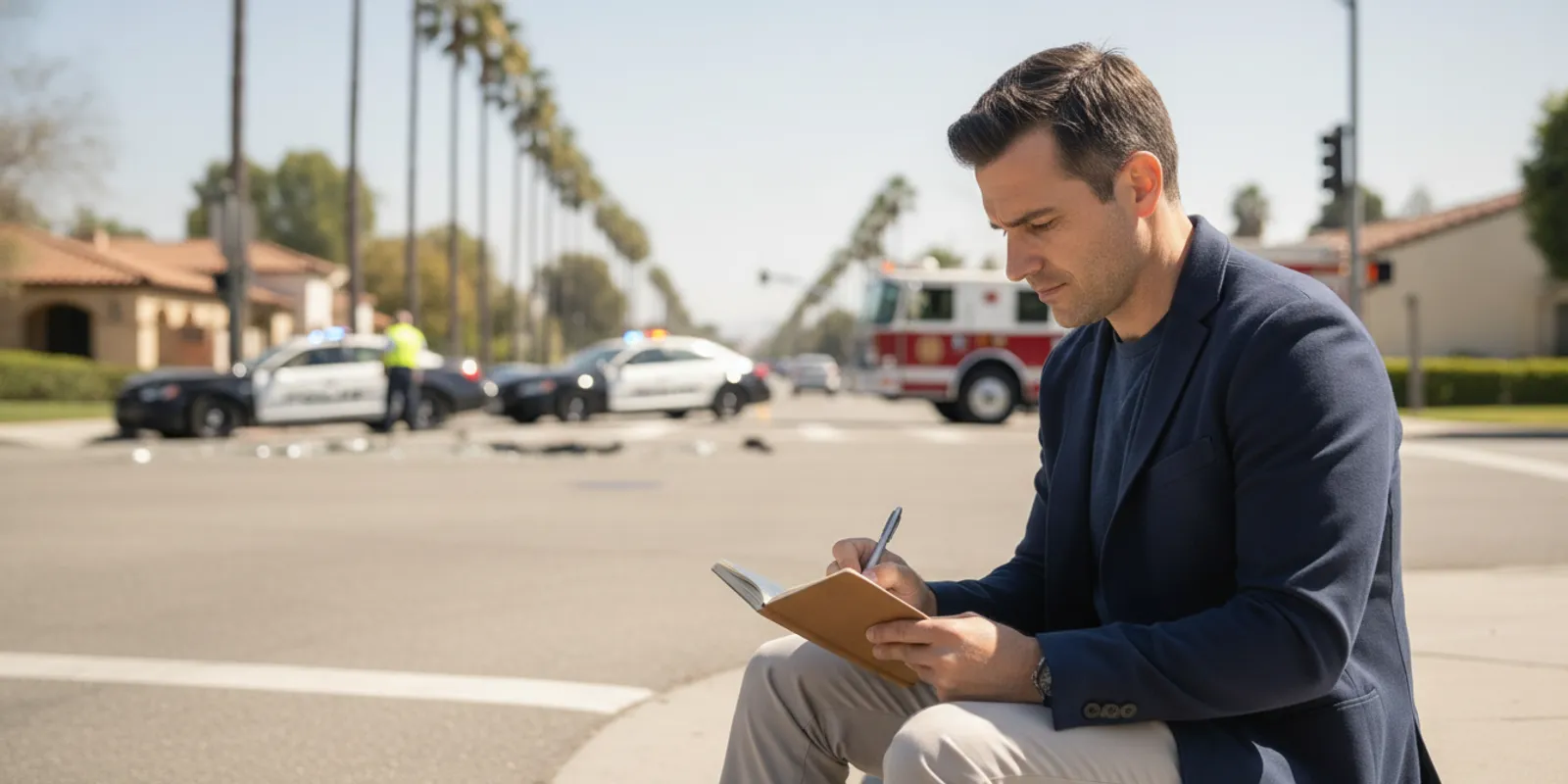
Once it is safe, make a first note of the time, place, and your vantage point. If you cannot write immediately, use a voice memo or message to yourself when safe, then create a fuller account later. Identify when the note was made. Do not present a later recollection as if it was recorded at the scene.
Keep your account within what you perceived. You can describe what you saw, heard, or did. You generally cannot know a driver's thoughts or exact speed without a reliable basis. If you did not see the moment of impact, say so. A partial but honest account is more useful than a complete-sounding story built from guesswork.
If you were also involved or injured, your circumstances may differ from those of a bystander. The firm's California auto accident information explains the firm's accident-related services. This article provides general information, not legal advice.
How can you record what you actually observed?
Write a short timeline from your own perspective. Begin with where you were and what you were doing, then list events in order. For example: “I was waiting at the northwest corner. I saw a blue sedan enter the intersection. I heard a horn, then saw the vehicles make contact.” This wording reports an observation without claiming why either driver acted.
Record the limits of your view. Note whether a parked vehicle, building, tree, or crowd blocked part of your sightline. Include whether it was dark, raining, or unusually bright, whether you were moving, and whether you looked away. If you missed a moment, leave that gap visible rather than filling it in.
- Place and position: Note the intersection or road, nearby landmarks, your direction of travel or facing, and where you stood or sat.
- Approximate time: Record the time if known. Label it approximate if you are estimating. Do not imply that a clock time is exact when it is not.
- Movement: Describe direction, lane, stopping, turning, or whether a vehicle appeared to move. Avoid unsupported conclusions about speed.
- Signals and conditions: Include a signal, sign, visibility, weather, or road condition only if you personally observed it.
- Sounds and words: Note a horn, impact, or statement you heard. Mark quoted words as approximate if you cannot recall them exactly.
- Afterward: Describe what you saw people do after impact, such as requesting help or exchanging information.
Use neutral verbs and concrete detail. “The car moved into the left lane” says more than “the driver recklessly cut someone off.” If you have an impression, label it as an impression and identify the observation behind it. Avoid declaring that someone was careless, distracted, or legally at fault.
One useful test is to ask: could a person standing where I stood have observed this? “I saw the light was red” may be firsthand if you had an unobstructed view of the signal at the relevant moment. “The driver was looking at a phone” is not firsthand unless you actually saw the phone and the driver's action. If you only heard another person say it, identify it as something you heard from that person, not as your observation.
What details and materials should you preserve?
A consistent method makes later review easier. Use a separate page or clearly marked section for each type of information rather than mixing observations with opinions. One useful layout has four columns: time, what you directly perceived, where you were, and confidence or limitation. For instance, “about 4:15 p.m.; heard a horn; standing inside the bus shelter; did not see which vehicle sounded it.” This records a specific event and its boundary in the same place.
Keep the original notes even if you later prepare a cleaner copy. On the copy, you can organize events or clarify shorthand, but retain the date you created it and do not silently remove uncertainty. If you correct a typo in the original digital note, preserve a version history or make a dated correction that shows what changed. The goal is not elaborate recordkeeping; it is an honest trail from first recollection to any later clarification.
Separate what happened before, during, and after the impact. A witness may remember a vehicle waiting at a light before looking away, then hear a crash, then see the vehicles stopped. Those are three observations, not proof of what happened in the unseen interval. A short timeline can say: “I saw the northbound car stopped. I looked toward the storefront. I heard a loud impact. I turned and saw two cars stopped in the intersection.” This is more precise than claiming the stopped car was struck while moving.
When describing distance or direction, use a fixed reference where possible. “The vehicle was near the driveway” is easier to understand than “it was over there.” You can sketch the street, mark your position, label north if known, and show the approximate location of each vehicle as you saw it. Mark the sketch “not to scale” if it is only a memory aid. A sketch should clarify your viewpoint, not imply measurements you never made.
Also preserve ordinary context that may explain a limitation. If you were speaking with someone, carrying groceries, crossing the street, or looking at a signal before turning away, record that candidly. If traffic noise made words hard to hear, note it. Details that limit an account do not make it useless; they help a reader understand what the witness could and could not perceive.
For digital material, keep the original device file and avoid sending the only copy through a service that may compress or alter it. Make a backup in a secure place, and keep a note of when and how you transferred a file. Do not add arrows, circles, timestamps, or explanatory captions to the original. If you make an annotated copy to explain a location, label it as a copy and retain the unmodified file alongside it.
Consider privacy before sharing a photograph that includes faces, license plates, children, or unrelated passersby. Avoid publishing it publicly. Ask the recipient how to submit materials securely and whether they need the original file. A witness can explain what the image shows without attempting to identify every person or infer what occurred outside the frame.
Preserve communication about the request as well as the account itself. Keep the email or message that explains who requested the statement, the date you sent it, and any follow-up. If you speak by phone, make a brief note afterward of the caller, date, and general subject. Do not record a conversation without first understanding the applicable rules and getting appropriate advice if uncertain.
How can you distinguish observation from inference?
Before sending an account, review each sentence and sort it into one of three categories: directly observed, heard from someone else, or inferred. The first category includes what your senses registered. The second identifies information another person supplied. The third includes explanations or conclusions drawn from what you observed. Keep the categories distinct in the wording.
For example, compare these statements: “The driver was speeding,” “The car crossed the intersection in about three seconds,” and “The car looked fast to me.” The first states a conclusion without showing its basis. The second gives a measurement only if the witness actually timed the event and has a reliable reference. The third honestly labels an impression, but still may be less useful than describing the car’s path and what happened next. Do not turn an impression into a fact by repeating it more confidently.
Use the same care with traffic signals. If you saw a green light several seconds before the impact but then looked away, say exactly that. Do not claim to know the signal at the instant of contact. If you saw a signal after the crash, it may have changed. Explain the timing rather than assuming it remained the same.
Likewise, distinguish a sound from its source. “I heard a bang” is a direct observation. “The red car hit the gray car” may be an inference if you did not see contact. A sequence such as hearing a bang and then seeing damaged vehicles is worth reporting, but the words should preserve what you did and did not witness.
If a person at the scene made a statement, write down the words as closely as you can and identify who said them, when, and whether anyone else was present. If you remember only the general meaning, use a paraphrase and label it as such. Avoid turning a vague comment into a precise quotation. Do not interpret a person's tone or facial expression as proof of a hidden motive.
Memory can change as people discuss an event or encounter photos and reports. If a later detail comes back to you, add a dated supplement rather than blending it into the first account. Note what prompted the recollection, if you know, and keep uncertainty visible. If you realize that a statement was mistaken, correct it promptly and plainly. Accuracy matters more than appearing perfectly consistent.
How can you prepare a concise account step by step?
A useful statement does not need dramatic language or a legal conclusion. Start with a short identification of yourself and your vantage point, then give the sequence you directly observed. Include the limits of your view and finish with available materials or a way to contact you. You can use this process before responding to a request:
- Write a private first recollection. As soon as practical and safe, note the date and time you are writing, the location, what drew your attention, and the events you remember in order.
- Mark certainty and gaps. Use phrases such as “approximately,” “I believe,” “I did not see,” or “I do not remember” where they accurately describe your memory.
- Check the viewpoint. Explain whether you were standing, seated, moving, inside, or looking through an obstruction. Identify when your attention shifted.
- Separate evidence from interpretation. Replace labels such as “reckless” or “at fault” with observable movement, sound, signal, or condition.
- Review names, dates, and contact details. Check that you can be reached and that any incident reference or recipient information is accurate.
- Read the final version aloud. Look for sentences that claim more than you observed, confusing pronouns, and absolute wording such as “always” or “never.”
- Keep a copy. Save the statement and any attachments together, along with a note of when and to whom they were sent.
Imagine a person who sees a cyclist enter an intersection, looks down to pick up a dropped bag, hears a collision, and then sees a car stopped beside the cyclist. A careful account might say, “I saw a cyclist enter from the east. I looked down briefly. I heard a crash and then saw a car stopped beside the cyclist. I did not see the point of contact.” It should not say that the car struck the cyclist while turning unless the witness actually saw that movement.
Another witness might see the full approach but be unsure about the light. That person can describe the vehicle directions, the point at which each entered the intersection, and the point where the view was blocked, while saying, “I could not see the signal.” There is no need to force the account into a complete narrative. A well-defined gap is more dependable than a guessed answer.
If an interviewer asks a compound question, answer the parts separately. For “Did you see the car speed through the red light?” you might respond that you saw the car enter the intersection, but did not see the signal clearly or cannot estimate speed. You can ask the interviewer to separate the question. This avoids accepting assumptions built into the wording.
What details and materials should you preserve?
Write down your name and a reliable way to reach you. If comfortable, share it with an involved person or an officer. Make sure the phone number or email is legible, and keep a copy or photograph of anything you hand over. You may note whether you spoke with an officer and any agency or incident reference you were given. Do not enter a restricted area or interrupt emergency work to obtain details.
If you took photographs or video from a safe and lawful place, retain the original files. Avoid editing, cropping, filtering, or adding captions to the original. If you need a working copy, keep it separate. A photo may show vehicle positions after impact, but it may not show how the vehicles arrived there; describe only what the image actually captures.
Keep notes, messages, and files somewhere you can locate them. A dated note or saved message can help distinguish your first account from later memory. Do not post names, images, or theories about the crash online. Public sharing can expose private information and remove a detail from its original context.
California's official DMV guidance explains what drivers involved in a collision must report in specified circumstances; it is not a witness-statement form, but it provides an official reference for the separate reporting process. See the California DMV collision-reporting guidance. A bystander should not assume that a driver's reporting duties automatically apply to a witness.
How should you share a written or recorded statement?
When someone asks for an account, ask who they are, who they represent, and how the statement will be used. A person may ask for a brief written account, a recorded interview, or another kind of information. Those are different formats. If the request is unclear or you feel pressured, take time to understand it before agreeing to a recording or signing a document.
For a written statement, read every line before signing or sending it. Correct inaccurate details, unclear wording, and statements that go beyond your memory. Do not sign a version that does not reflect what you said. If unsure, say “I do not recall” or “I am not sure.” Do not sign a blank or incomplete form.
During a recorded conversation, listen to the whole question and answer only what you know. Ask for a question to be repeated or clarified. Do not accept a suggested detail just because it sounds plausible. If you need a break, say so. If you later remember something material or notice an error, contact the recipient and explain the correction rather than silently changing your account.
Do not coordinate memories with other witnesses. It is reasonable to exchange contact details, but avoid comparing versions or trying to make accounts match. Each person should describe their own independent recollection. Do not speculate about what another witness could see from a different vantage point.
Which way of recording a statement fits the situation?
Different formats preserve different things. Choose what you can accurately maintain, and do not treat any one format as a complete record of the collision.
| Format | What it can capture | Practical care |
|---|---|---|
| Private notes | A timely timeline and details to refresh your memory | Date them; label uncertain details and keep the original |
| Written account | A reviewable description shared with a requester | Check every sentence and correct it before signing |
| Recorded interview | Your spoken recollection in response to questions | Understand who is asking; clarify questions and avoid guessing |
| Photo or video | What the camera captured from one viewpoint | Preserve the original and do not treat it as the whole event |
For example, a witness who saw vehicles only after the collision can accurately describe their location and visible damage, but should not claim to have seen the impact. A person who heard a crash from indoors can report hearing a sound and then seeing vehicles outside, while being clear they did not see how the crash happened. Matching the format to what you know keeps the account measured.
What should a witness avoid?
- Do not guess. If you did not see the signal or cannot estimate distance reliably, say that.
- Do not adopt another person's account. A driver's explanation is not your own observation.
- Do not exaggerate or minimize. Include inconvenient details as accurately as favorable ones.
- Do not patch memory gaps. Mark later recollections as later recollections, with when you remembered them.
- Do not alter source material. Retain original photos, video, and messages.
- Do not decide legal fault. Describe events and conditions, not their legal meaning.
- Do not share sensitive information publicly. Give relevant information through an appropriate channel.
These cautions do not mean you must remain silent. They help keep the account reliable. You can ask for a request in writing, clarify the requester's role, or seek independent legal guidance if you have concerns. A witness's interests may differ from those of a person involved in the crash.
What if an insurer or attorney contacts you?
Ask for the caller's name, organization, callback number, and the people or claim involved. You can verify the caller independently before returning a call. Note when the conversation occurred and what was requested. Ask whether the person wants a written account, recorded interview, or another type of information.
You are not required to pretend to remember more than you do. Explain if your view was blocked or if you are uncertain. If asked to review a document, flag language that is not yours or changes your meaning. If someone requests sensitive personal information, understand why it is needed and how it will be handled before providing it.
If you were a party to the crash as well as a witness, or have concerns about your own potential responsibility, consider advice specific to your circumstances. Mamanne Law describes its attorney-led approach. No article can assess an individual matter.
How can you keep your account clear over time?
After sharing a statement, record who received it and when. Save copies of emails, forms, and messages. Before a later conversation, review your original notes so you can distinguish what you recalled at the scene from anything remembered afterward. Do not rewrite the original account to make it appear every detail was written immediately.
If you receive a subpoena or another formal legal document, do not ignore it. Read it carefully, note deadlines or appearance details, and seek appropriate legal guidance if you have questions. A request from an insurer is not the same as a court order; ask for clarification if you do not understand a document.
If you left the scene before sharing important information, use an appropriate official or involved-party contact channel. Keep your message factual and brief. Avoid repeated contact or approaching anyone in a way that feels unsafe.
Frequently Asked Questions
Should I give a statement if I did not see the entire crash?
You can describe the part you observed and explain what you could not see. A partial account may preserve a useful detail, but do not fill gaps with assumptions.
Can I estimate a vehicle's speed?
Only give an estimate if you have a genuine basis and can explain how you formed it. If you are not confident, describe movement without assigning a speed.
What if I remember something after giving my account?
Contact the recipient, explain what you now recall and when you remembered it. Be clear that it is a later recollection, and do not quietly replace the earlier account.
Do I have to speak with every insurance company?
Do not assume each caller has the same role or that every request has the same effect. Ask who is contacting you and why, and consider independent guidance before agreeing to a recorded interview or signing a formal statement.
What is a practical next step?
If you witnessed a California collision, write down your own observations while they are fresh, preserve your contact details and original materials, and be candid about what you do not know. If you were injured, you can review Mamanne Law's personal injury services, learn about Benjamin Mamanne, or read answers to common questions.
Call Mamanne Law at (818) 528-6376 to request a case evaluation.
A careful witness statement is a truthful account of what you personally observed, shared without pressure or guesswork.