
Bicycle accidents · General information
Bicycle Accident Lawyer Los Angeles: Your Crash Rights
Bicycle accident lawyer los angeles guidance on crash steps, California rules, evidence, deadlines, and choosing help for a free case evaluation.
A bicycle crash in Los Angeles can leave you managing pain, transportation problems, missed work, and difficult conversations with insurers at the same time. The steps you take early can help protect your health and preserve information about what happened.
A bicycle accident lawyer los angeles may help investigate the crash, identify potentially responsible parties, organize evidence, communicate with insurers, and evaluate whether a claim may be available under California law. The right next steps depend on the specific facts, including the roadway, vehicles, witnesses, injuries, and available records.
This guide explains what to do after a collision, how California rules and deadlines can affect a claim, what evidence may matter, and how to assess attorney-led support. Start with the immediate priorities that can make later decisions clearer.
What Should You Do After a Bicycle Crash in Los Angeles?
A bicycle crash can leave you shaken, hurt, and unsure what to do next. If you are able, focus first on immediate safety and clear documentation. California DMV guidance explains that bicyclists have many of the same rights and responsibilities as motorists, so the circumstances of the collision matter when an injury claim is evaluated.
- Move to a safe location if possible. If you can do so without worsening an injury, get out of active traffic and ask someone to call 911 when emergency help is needed. Avoid arguing with the driver, and do not leave the scene before exchanging information unless safety or medical care requires it.
- Request medical attention and follow up on symptoms. Some injuries may not be obvious immediately after a crash. Consider seeking prompt medical evaluation and keep records of visits, instructions, prescriptions, and other treatment-related information. This is general information, not individualized medical advice.
- Exchange information and report the collision. Obtain the driver's name, contact information, license plate, insurance details, and vehicle description when it is safe. Ask whether witnesses will share their names and contact information. A police report may also preserve important details about what happened.
- Preserve evidence. Take photographs or video of the scene, traffic controls, road conditions, bicycle damage, visible injuries, nearby vehicles, and relevant property damage. Keep damaged equipment and clothing, and save messages, receipts, and records related to the crash. Do not repair or discard the bicycle before its condition is documented.
- Be careful when speaking with insurers. Notify the appropriate insurer as required, but avoid guessing about fault, minimizing your injuries, or accepting a settlement before you understand the claim. Preserve all correspondence and ask questions if an insurer requests a recorded statement or broad medical authorization.
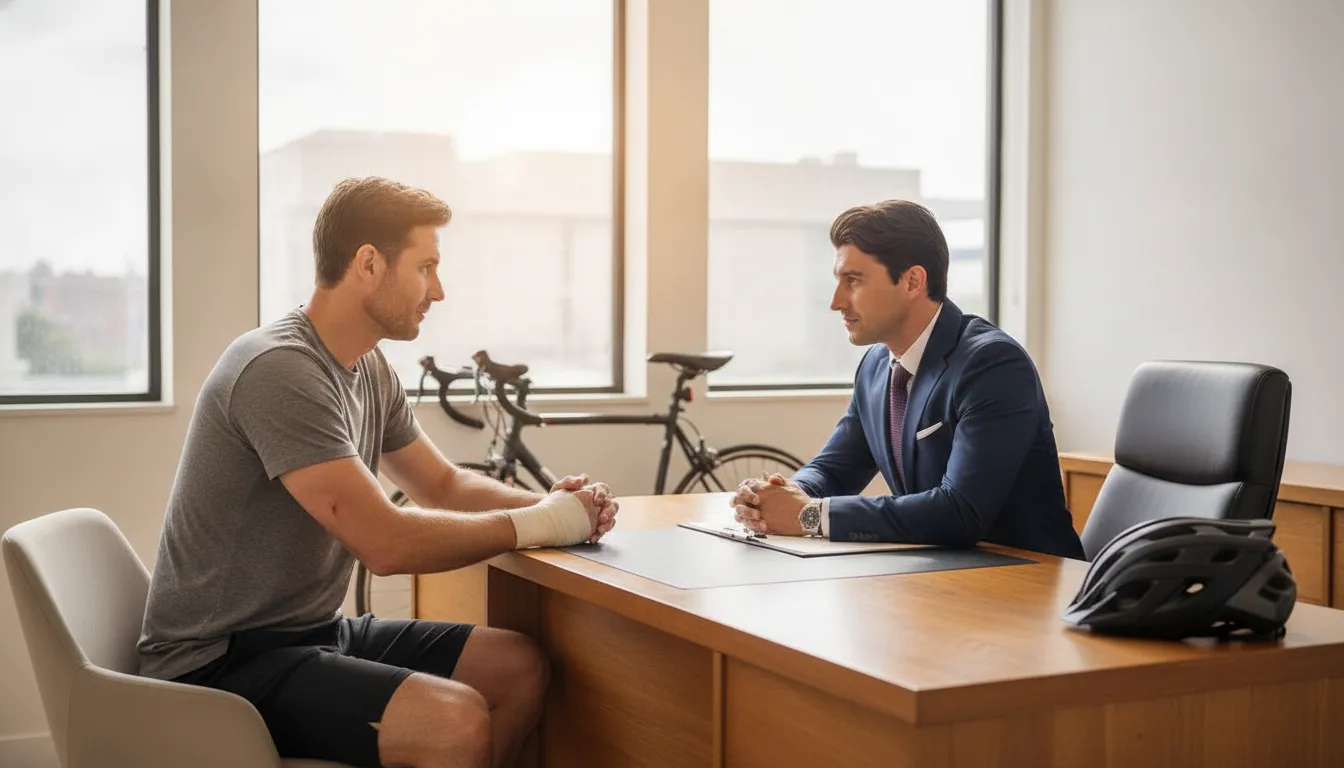
After these initial steps, an attorney can help investigate the crash, organize evidence, coordinate claim paperwork, and communicate with insurers. Mamanne Law offers attorney-led case evaluations for people injured in Los Angeles and throughout California, but whether a claim is available depends on the specific facts.
How California Bicycle Laws Can Affect an Injury Claim
California treats bicyclists as roadway users with many of the same rights and responsibilities as motorists. The California Department of Motor Vehicles explains that people riding bicycles must follow applicable traffic signals, stop signs, and right-of-way rules. Drivers must also operate carefully around bicycles. These rules can matter when an insurance company or attorney evaluates how a crash happened, although the facts of each collision determine whether a particular rule was violated.
For a plain-language overview of bicycle safety and traffic responsibilities, the California DMV bicyclist and pedestrian guide is an appropriate starting point. It explains that bicyclists should ride predictably, obey traffic controls, and leave enough room between themselves and parked vehicles to reduce the risk of being struck by an opening door.
California's passing rule is especially important in many bicycle crashes. Under California Vehicle Code Section 21760, a driver generally must not pass a bicycle in the same direction with less than three feet between the vehicle and the bicycle or its operator. If the driver cannot safely maintain that distance, the law requires slowing to a reasonable and prudent speed and passing only when it is safe. When practicable and safe, the driver may also need to change into an available lane.
The three-foot rule does not automatically establish responsibility for every collision, and a close pass is not the only fact that may matter. Investigators may also examine traffic signals, lane position, visibility, roadway conditions, vehicle damage, witness accounts, and whether each person had a reasonable opportunity to avoid the impact. Avoid assuming that a citation, a traffic rule, or an insurance company's initial explanation settles the claim. Preserving the available evidence and obtaining a careful review can help clarify which rules and circumstances apply.
What Evidence Helps Show Who Caused a Bicycle Crash?
Document the scene and the vehicles
Determining responsibility after a bicycle crash usually requires more than identifying which vehicle made contact. The important question is what each person was doing immediately before the collision, what the roadway allowed, and whether the available evidence supports one account over another. A careful investigation can help preserve those details while they are still available.
If it is safe to do so, photographs can help show the intersection, lane markings, traffic signals, parked cars, sight lines, roadway conditions, bicycle position, and visible damage. Capture multiple angles rather than relying on one close-up. Images of a vehicle's location, mirrors, doors, bumper, lights, and damage may help explain how the crash occurred. Keep the bicycle and damaged equipment in their post-crash condition when practical, and do not repair or discard them before they can be documented.
California rules and safety guidance can also provide context. The California Department of Motor Vehicles explains that bicyclists must obey stop signs, red signal lights, and basic right-of-way rules. It also advises cyclists to keep enough distance from parked cars to avoid being struck by an opening door. That guidance does not decide liability in a particular case, but it identifies facts that may need to be examined. This includes whether a driver opened a door into a cyclist's path or whether traffic controls affected the movements of either person. See this California bicycle accident claim guidance for additional California-focused information.
Identify witnesses and preserve records
Names and contact information for people who saw the crash can be valuable, particularly when accounts differ. Save photographs, videos, dashcam footage, helmet-camera files, messages about the incident, police or incident-report information, and communications from insurers. Store original files when possible, including the date and time information attached to them. A nearby business, residence, or traffic system may have video that is overwritten quickly, so identifying possible footage early can matter.
Medical records and bills can help document the injuries and treatment connected to the collision. Keep records of missed work, bicycle or equipment damage, and other related losses as they become available. These materials do not prove fault by themselves, but they can help establish the effects of the crash and the scope of a potential claim.
Why an investigation matters
Fault may depend on several facts considered together, including statements, physical evidence, roadway design, traffic rules, visibility, and the timing of each person's actions. An insurance company's initial version of events is not necessarily a complete investigation. Mamanne Law's approved process includes investigating crash circumstances, assessing liability and damages, and gathering evidence. A bicycle accident lawyer in Los Angeles can review the available information and explain what additional records or witnesses may be relevant, without promising a particular conclusion.
What Losses Can a Bicycle Accident Claim Address?
A bicycle crash can affect much more than the moment of impact. Depending on the facts, an injury claim may address losses connected to physical harm, time away from work, emotional distress, and damage to personal property. California Courts explains that personal injury compensation may include medical bills, lost wages, emotional harm, and other losses caused by an injury. Read the California Courts overview of personal injury claims for general information.
Medical expenses and treatment needs
Medical-related losses can include bills for emergency care, follow-up visits, diagnostic services, rehabilitation, and other treatment connected to the crash. Keeping records of appointments, bills, prescriptions, and related expenses can help document what happened after the collision. The nature and extent of an injury, as well as its connection to the crash, must be evaluated based on the available facts.
Lost wages and emotional harm
If an injury affects your ability to work, the claim may involve income lost during recovery or other work-related effects. A serious crash may also cause pain, anxiety, frustration, or other emotional harm. These experiences are personal and should be described accurately rather than reduced to a generic label. Records and consistent communication can help show how the injury affected daily life.
Property damage and claim coordination
A collision may damage a bicycle, helmet, clothing, phone, or other personal property. Property damage is addressed separately from the physical and emotional effects of an injury, but the information can be part of the overall claim process. Mamanne Law can assist with insurance claims, paperwork, property damage coordination, treatment coordination, and negotiations. That assistance may help organize the process while the claim is investigated, but no particular result is guaranteed.
Because losses vary from one crash to another, an evaluation should consider the available records, the circumstances of the collision, and the ways the injury has affected your life.
Why Do Fault and California Deadlines Matter?
After a bicycle crash, responsibility may not be obvious from a brief description of what happened. Drivers, cyclists, passengers, road conditions, traffic signals, visibility, and witness accounts can all matter. California bicyclists have the same rights and responsibilities as motorists, according to the California DMV. That means an insurance carrier or court may examine the conduct of everyone involved rather than assume that one person is automatically at fault.
For example, California law generally prohibits a driver from passing a bicycle with less than three feet between the vehicle and the bicycle or its operator. If traffic or roadway conditions prevent that distance, the driver must slow to a reasonable and prudent speed and pass only when doing so would be safe. The exact circumstances still matter. A claim may require looking at the crash location, vehicle damage, photographs, video, statements, and applicable traffic rules. Those facts can help clarify whether another person's negligence contributed to the collision, whether the cyclist's conduct is being questioned, or whether responsibility may be shared.
Timing matters for a separate reason. The California Courts explanation of statutes of limitations lists personal injury as generally having a two-year period from the injury. That is a general rule, not a case-specific deadline or a substitute for legal advice. California Courts also explain that limitation periods are fact-specific and can be difficult to calculate. Different requirements may apply when a government agency or someone working for one is involved. In some circumstances, discovery or tolling can affect when a period begins or whether it is extended.
A late filing can jeopardize the ability to pursue a claim, so it is safer to address timing early rather than rely on an insurance conversation or an assumption about the date. Preserving evidence and identifying all potentially responsible parties can also become harder as time passes.
If you want help understanding which facts and deadlines may need attention, you can request a free case evaluation or call or text Mamanne Law at (818) 528-6376. An attorney can review the specific circumstances without promising a particular outcome. Mamanne Law may assist with investigating the crash, gathering records, and communicating about an insurance claim, subject to the facts of the case.
How Can a Bicycle Accident Lawyer in Los Angeles Help After a Crash?
Choosing legal help after a bicycle crash is about more than finding a familiar phrase in an advertisement. Look for an attorney who will listen carefully to what happened, explain the process in plain language, and make clear who will handle important decisions. You should also feel comfortable asking how the firm communicates, what information it needs, and whether it has experience evaluating the kinds of evidence that may matter in a California bicycle injury claim.
A useful first step is to ask whether the attorney will personally review your situation. A crash may involve roadway conditions, vehicle movement, witness accounts, insurance communications, medical records, and property damage. The significance of each detail depends on the facts. An attorney-led review can help organize those details and identify questions that require further investigation, without assuming the outcome of the claim.
What to look for in legal support
- Clear communication: The firm should explain next steps, requests for records, and communications with insurers in terms you can understand.
- Focused investigation: Ask how the firm evaluates crash circumstances, gathers available evidence, and assesses issues involving responsibility and losses.
- Personal attention: Find out who will review the case and who you can contact when a new question arises.
- Practical assistance: Depending on the circumstances, support may include claims reporting, paperwork, insurance communication, property damage coordination, and coordination related to medical treatment.
| Question to ask | Why it matters |
|---|---|
| Who will personally review my case? | Clarifies who will assess the crash facts and guide important decisions. |
| How will you investigate the collision? | Shows whether the approach accounts for witnesses, roadway conditions, records, and physical evidence. |
| How will communication work? | Sets expectations for updates, questions, paperwork, and insurer communications. |
Mamanne Law is a boutique, family-owned California personal injury firm based in the Northridge area of Los Angeles and serving clients statewide. Benjamin Mamanne personally reviews cases, and the firm's approach emphasizes direct attorney involvement, empathy, and ongoing communication. That model is intended to give an injured cyclist a clear point of contact while the firm investigates the crash and considers potential claim issues. It is not a promise that every case will result in compensation.
You can learn more about the firm's bicycle accident representation while considering whether its approach fits your needs. During an evaluation, describe what happened as accurately as possible and bring available crash reports, photographs, insurance information, medical records, witness details, and communications related to the incident. An attorney can then discuss the facts of your situation and explain possible next steps. Mamanne Law offers free case evaluations, with consultations available in appropriate circumstances by phone, virtually, in person, at home, or at a hospital.
What Should You Ask During a Free Case Evaluation?
A free case evaluation is an opportunity to explain what happened and learn which issues may affect your options. It is also a chance to decide whether the attorney's communication style and approach feel appropriate for your situation. You do not need to have every answer before the conversation. Start with a clear account of the crash, then ask questions that help you understand the process.
Questions about the crash and potential claim
- What facts will matter most when evaluating responsibility for the collision?
- What evidence should I preserve, including photographs, video, witness information, bicycle damage, and insurance records?
- How might my medical treatment, time away from work, or other effects of the injury be considered?
- What information is still missing, and who may be able to provide it?
- What should I say to an insurance company, and should the firm help coordinate that communication?
These questions invite a discussion of the specific circumstances instead of asking for a guaranteed prediction. A careful review may need to account for roadway conditions, vehicle conduct, witness accounts, available insurance, and the nature of your injuries. The answer can change as additional records or evidence become available.
Questions about communication and case support
- Who will be my primary point of contact?
- Will an attorney personally review my case and remain involved in important decisions?
- How will I receive updates about investigation, paperwork, negotiations, and other next steps?
- Can you explain the fee arrangement in plain language, including whether there are upfront legal fees?
- What are the next decisions I need to make, and what should I avoid doing while the claim is reviewed?
Consider bringing a photo ID, the date and location of the crash, a short timeline, and the responding agency information. Also bring insurance details, photographs, videos, witness names, medical records or bills, employer information about missed work, and copies of messages from insurers. Bring your bicycle and damaged equipment information if relevant, but do not discard or repair important evidence without documenting it first.
Mamanne Law offers free case evaluations, and consultations may be available virtually, in person, at home, or at a hospital depending on the circumstances. Same-day availability may be possible. To discuss your situation and request an evaluation, contact Mamanne Law or call or text (818) 528-6376.
Frequently Asked Questions
Can you sue someone for hitting you on a bike?
Possibly. A claim may be available when another person's negligence caused the crash and your injuries or losses. The facts matter, including traffic conditions, witness accounts, vehicle conduct, photographs, medical records, and any available insurance coverage. An evaluation can help determine whether further investigation is appropriate.
How much compensation can you receive for a bicycle accident?
There is no reliable one-size-fits-all amount. Potential losses may include medical bills, lost wages, property damage, emotional harm, and other injury-related losses. The value of a claim depends on the evidence, the nature and duration of the injuries, responsibility for the crash, and applicable insurance. No attorney can responsibly promise a particular result before reviewing the case.
How long do you have to file a bicycle accident claim in California?
California Courts explains that personal injury lawsuits are generally subject to a two-year deadline from the injury, but exceptions and different rules may apply. Discovery, tolling, claims involving government entities, and other facts can affect timing. See the California Courts statute of limitations guidance, and seek case-specific advice promptly rather than relying on a general rule.
What should you bring to a bicycle accident case evaluation?
Bring or identify the crash date and location, photographs or video, witness contact information, police or incident reports, insurance details, medical records and bills, wage-loss information, and messages from insurers. If some records are unavailable, do not delay asking for help. A lawyer can explain what additional evidence may be useful and discuss possible next steps.
Contact Us About Your Bicycle Crash
A conversation can help you understand your options and decide what information to gather next. Call or text Mamanne Law at (818) 528-6376 to request a free case evaluation. You can share what happened, ask questions about the next steps, and learn whether speaking with the firm may be appropriate for your situation.